Pages

Showing posts with label Brexit. Show all posts

Monday, May 8, 2023

CONVERTING TRADE INTO POWER – The European Single Market at 30

Reflections on Europe Day 2023

by George I. H. Cooke


The impact of trade on countries that engage in it heavily internationally, and the overall effect it is having on international relations as a whole, continues to baffle. European historian, Norman Davis, points out that “Western Europe’s greatest success story lay in the realm of economic performance. The speed and the scale of economic resurgence after 1948 was unprecedented in European history, and unmatched in any part of the world except Japan. It was so unexpected and spectacular that historians cannot easily agree on its causes. It is far more easily described than explained.”

Herein lies the crucial argument for trade and its intensification, which the European Union, as the foremost model of integration, has been able to achieve. As the Union marks three decades since the establishment of the Single Market, it is prudent to reflect upon that which has been achieved individually by countries, and collectively by the region.

Geared towards facilitating the free flow of goods, services, people and capital, the depth of integration was first envisioned in 1957 through the Treaty of Rome. Considered to be well ahead of its time, the Treaty proposed the reduction of customs duties, establishment of a customs union, creation of a common market, as well as common transport and agricultural policies, and even envisaged the setting up of the European Commission, which is one of the most unique institutions in multilateral bodies.

It was the signing of the Maastricht Treaty on 7 February 1992, that led to the establishment of the Single Market on 1 January 1993 bringing together 12 EU countries, notably, Belgium, Denmark, Germany, Ireland, Greece, Spain, France, Italy, Luxembourg, the Netherlands, Portugal and the United Kingdom. With the expansion of the Union, the Single Market now comprises of the 27 EU Member States and also includes Iceland, Liechtenstein, and Norway, while Switzerland has a degree of involvement as well.

The European Commission highlights that the Single Market has been able to make three distinct shifts - ‘accelerating the transition to a greener and more digital economy; guaranteeing high safety and leading global technological standards; and responding to recent crises with unprecedented speed and determination” – but from an analytical point of view, it has made the European Union one of the strongest trading blocs, and boosted its currency globally. This translates to power on the world stage, that many other regions which have attempted integrating can only aspire to, and are yet to realise.

While the deepened integration might be questioned against the backdrop of the exit of the United Kingdom, it needs to be examined for the progress and impact made over the last three decades. Greece, is probably the EU member that has faced the most trying of financial times in recent years, hence the Greek Foreign Ministry’s assertation that “the seamless operation of the Single Market is a precondition for a strong economy that will benefit all Member States, citizens and businesses and that will meet the conditions of global competition,” is testimony to its resolute commitment to the Single Market. In contrast, Germany, seen as the foremost and strongest economy in the Union, has benefited immensely from the Market. The Bertelsmann Foundation notes that “Germany benefited most in absolute terms from the single market, earning an extra 86 billion euros ($96 billion) a year because of it.”

At first glance it appears that all countries are benefitting from the Single Market, but it is important to note that the advantages accrued vary from one member state to another, and is largely dependent on their size, economy and strength. There is relative gain with Germany for example gaining tremendously, and Greece gaining relatively less, but gaining nonetheless.

Arguments on the contrary claim that the Single Market remains an illusion, which is yet an ‘ongoing project’ despite its many decades of implementation. Fredrik Erixon and Rositsa Georgieva of The Five Freedoms Project, claim that “While the nature and profile of the Single Market, and its regulations, have changed over the years, they often have focused on the wrong issues, or on factors that would not change the nature of markets as such.” This observation relates specifically to the Services sector, with their further claim that “The piecemeal approach to reform, followed until now, has created a complex web of regulations, administrative rules, national discretion, and partial freedoms. Fractional and incomplete liberalization have reduced the potential gains.”

Similarly, highlighting the legal obstacles to implementation, Copenhagen Economics, points out that “the functioning of the Single Market is a shared responsibility between the EU and the Member States. Differences in interpretation and application of EU law are inevitable. Despite years of hard work and substantial real progress, we appear to be some distance from having a well-functioning Single Market, free from unjustified or inappropriate obstacles to free movement.”

Although three decades might not have yielded a completely consolidated system it does however indicate much progress that is yet to be achieved by other regional groupings. The EU Commissioner for Internal Market, Thierry Breton argues that the Single Market is “much more than just a legal framework – or indeed a market. We need to continuously preserve, improve and re-invent this formidable asset.” Breton calls for three crucial measures to ensure that progress. He notes that “first, by ensuring that the rules we have agreed collectively are also applied collectively. Second, by putting SMEs at the centre of Europe’s competitiveness. Third, by ensuring that people and businesses have access to the goods and services they need, when they need them.”

While Breton’s assertion contributes to the concept of the Single Market being an ‘ongoing project’ it indicates the need for collective action for any progress across the grouping. This collective action might not always be forthcoming owing to domestic developments as seen with Brexit, and its impact on the region in particular, and regionalism in general. While Brexit delayed deeper integration, it also raised the question over the amount of integration. However, the United Kingdom had first raised concerns about the European model two years after joining in the mid-1970s. Therefore, the example of the Brexit needs to be examined in different light. Of relevance however, is continuous call for collective action. If Member States pull in different directions, or differ largely over policy and its implementation, the model is on rocky ground.

Yet the acceleration of economic development across the region, the enhancement of trade, and the removal of barriers, has led to the Single Market remaining a firm foundation upon which countries are able to build solid cooperative mechanisms. The Single Market also causes a return to the basic understanding that those who trade are less likely to engage in conflict.

A decade ago, the Stanford Graduate School of Business focused on the research of Matthew O. Jackson and Stephen Nei, who suggested that “military alliances alone aren’t enough to stop nations from attacking one another, and also that the addition of multilateral economic trade creates a more stable, peaceful world.” In their paper on Networks of Military Alliances, War and International Trade, Jackson and Nei observed that “once you bring in trade, you see network structures densify…trade motives are essential to avoiding wars and sustaining stable networks.”

Member States of the European Union embarked on an ambitious programme of integration after the Second World War with trade remaining at the centre, but these members did not sacrifice defence either, and many are Members of the North Atlantic Treaty Organization (NATO). Thus, military alliances have not been completely forgotten or sidelined, but have been nurtured too, and especially so in the last three decades. After the collapse of the Soviet Union and the end of the Cold War, NATO evolved, and this evolution is attributed to Member States taking concrete action to ensure their preparedness if and when required.

While Europe has been able to avoid war among its constituent, yet sovereign entities, it is today grappling with war on its border as Ukraine and Russia continue to engage violently. However, NATO not activating a no-fly zone over Ukraine despite demands for the same from Ukraine, has probably been the saving factor that has ensured that war has not spilt over into Europe, and in fact the entire world.

The collective military might, coupled with the trade prowess, has given the European Union a higher degree of power. Three decades after the Single Market came into operation it is relevant to question whether trade ensured the inclusion of power into the equation, especially in light of the strength of the currency of the EU, and its financial markets. A currency of several European member states used by approximately 340 million people daily, is today the second most widely used currency globally, with 60 partner countries or territories also using the currency in some form.

The 69th plenary meeting of the Conference of Parliamentary Committees for Union Affairs (COSAC) is due to convene in Sweden next week. A background note for the session on the Single Market has been circulated prior to the meeting. It claims that “Over the last three decades, the single market has promoted healthy competition and created strong economies and industries across the continent. The removal of barriers for goods, services, capital and people has given us both better companies and more thriving countries, and has provided consumers with higher quality products at better prices. The single market also makes it easier to travel, study, work, live and retire in other member states…. The single market also contributes to the Union’s unique peace project as it has generated increased trade, closer contacts and greater mobility within the Union.”

Trade transposed a region that fought two world wars in the short span of two decades, and has managed to remain relatively peaceful and devoid of conflict for over seven decades. It is granted that challenges remain deeply entrenched, and much doubt is raised over collective action, but it is also true that the European model of integration remains unique and in a league of its own, well ahead of the rest. Davies’ claim remains accurate as the progress “is far more easily described than explained.”


Wednesday, January 29, 2020

BREXIT AND BEYOND: STRATEGIZING BRITISH FOREIGN POLICY IN 2020 THROUGH THE COMMONWEALTH


by George I. H. Cooke

As the United Kingdom exits the European Union, and Euro-skeptics draw parallels to a doomsday scenario, in which more members will opt to leave, it is relevant to reflect upon the United Kingdom, the country that is to be directly impacted in the months and years ahead. Member states of the EU still have each other and even have neighbours such as Serbia, Montenegro, Albania and even Turkey, all of whom are keen to gain membership. The EU will ride out the storm that hit it in the last five years since the now infamous referendum which David Cameron promised and held, and respected as he exited Downing Street. His successors have gambled as did Theresa May in holding elections and hoping to obtain a larger majority, but instead lost more seats. Her successor Boris Johnson, who was one of the architects of Brexit, who campaigned vigorously with Nigel Farage of the United Kingdom Independence Party for Brexit in 2005, had more success in the polls in 2019 and is now prepared to lead his country out of the regional grouping. 

What options lie ahead for the United Kingdom? How will foreign policy be impacted? What will happen to the position of leadership the UK enjoys on the world stage? While questions abound, it is relevant to focus on the mechanisms within the United Kingdom which the country has relied on for centuries and attempt to understand how the UK has weathered many a storm and still retained its advanced place on the world stage

The United Kingdom, having ruled large swathes of the world for most of the 19th and 20th centuries and yet after giving up the empire in stages throughout the second half of the last century, has proved her ability to remain relevant and resilient against many odds. Having been a dominant naval power, which transformed into an industrial power house and built a remarkable empire which conquered countries across continents, the loss of one of its initial colonies, America, was soon overcome through a galaxy of other acquisitions of territory, earning for itself the designation of being an empire on which the sun never set.

As the 1st of February 2020 dawns, the United Kingdom will turn another page in its dotted history, and gradually, but surely return to its position of prestige on the world stage. The referendum of 2015 is now a part of history and the steps being taken, although not irretrievable are certainly momentous for a country that shook the very fundamentals upon which two particular concepts of International Relations discourse, those of sovereignty and regionalism, have long been established.

Sovereignty challenged from within

The calls for the referendum centered on numerous issues, one being the diminishing sovereignty that the British people enjoyed over their policy formulation and implementation, as it was argued that Brussels, dictated terms and conditions. This, it was noted, was owing to the supranational form of cooperation that the European Union created. British people must decide on their own future, was the call, in a bid to strengthen sovereignty of a country that had delicately balanced and ensured a Union of its own for centuries. Yet the day after the referendum, when Nicola Sturgeon, first Minister of Scotland said that she intended “to take all possible steps and explore all possible options to give effect to how people in Scotland voted - in other words to secure our continuing place in the EU, and in the single market in particular”, alarms bells rang at Downing Street and the new Prime Minister Theresa May flew swiftly to the north to reassure Sturgeon.

The Scottish leader’s statement that she thought “an independence referendum is now highly likely but I also think it is important that we take time to consider all steps and have the discussions, not least to assess the response of the European Union to the vote that Scotland expressed yesterday,” was not what was expected by leaders in London, or even hard line Brexit campaigners. Even if they had not envisaged such an outcome, they certainly hadn’t bargained for such stiff resistance from Scotland in relation to the results.
Theresa May’s “commitment to preserving this special union that has endured for centuries” was a quick fix attempt to reassure the people of Scotland that despite their leaders’ sentiments, the central government would respect the “union, not just between the nations of the United Kingdom, but between all of our citizens.” Sovereignty and its preservation, which had been a crucial element of the Brexit campaign, was under fresh strain, not from Brussels this time but from within the United Kingdom itself.

Similarly, views expressed by Gerry Adams, the Sinn Fein President that “the British government should respect the popular vote in the North for European Union membership by bringing forward a referendum on Irish unity. The Irish government, too, should act on this,” created further concern as another integral part of the country, which shares the only tangible border with the EU, was appearing to test sovereignty at its very core. Given that the Good Friday Agreement and relative peace in Northern Ireland, arrived at through a delicate and complex process, might be jeopardized, the cautious note of the Prime Minister led to her delaying invoking Article 50 to commence the process of leaving the Union.

Regionalism threatened

The European Union is held up as the most integrated, progressive and visionary regional grouping of all those that exist at present. From its initial steps through the Coal and Steel pact, to the complex, multinational union of today, the EU has been the epitome of regionalism. Yet the results of the 2015 referendum sent shudders through this hugely consolidated structure with nationalist frontrunners such as France’s Marine Le Pen claiming that “this is the beginning of the end of the European Union. And I hope the birth of the Europe of nations, a Europe of cooperation that we’ve been propounding for years.”

Geert Wilders, leader of the Party for Freedom in Netherlands proclaimed that “We want to be in charge of our own country, our own money, our own borders, and our own immigration policy. As quickly as possible the Dutch need to get the opportunity to have their say about Dutch membership of the European Union.” Related issues such as the Euro were being raised in Italy with Luigi Di Maio, Vice President of the Lower House of Parliament stating that “We want a consultative referendum on the Euro. The Euro as it is today does not work. We either have alternative currencies or a 'Euro 2’”. The decade long process of building a region of stability and certainty upon this overarching concept of regionalism was facing its gravest threats.

Other regional blocs, which aimed to emulate the EU and its comprehensive progress, especially in understanding mechanisms such as the European Commission, which remains one of the most unique apparatus aimed at protecting regional interests over national interests, were suddenly faced with the daunting question of whether integration needs to adopted only up to a certain stage, and if the EU had integrated too much.

United Kingdom: Having it her way

The ensuing crisis created by the referendum and the need for its implementation, given the democratic form of governance prevalent in the United Kingdom, was yet another scenario unfolding in which the UK had had her way. From the refusal to convert the Sterling Pound to the Euro and the rejection of the offer to join the Schengen Agreement, the UK has consistently ensured that she was able to chart her own course despite being within a grouping such as the EU.

In the developments post January 2020 it is apparent that the United Kingdom will once again push for swift settlement of the multitude of issues arising out of this move to depart. From travel to savings, pensions, investments, personnel, the value of the Pound, the proposed Free Trade Agreement, the border with Northern Ireland and numerous other issues that require settlement, the task ahead for British leaders is daunting to say the least, but undoubtedly a challenge they will accept and emerge from relatively unscathed, if past experiences are to be relied upon. 

The United Kingdom is today a United Nations Security Council Permanent Member, a position retained through her victorious alliance during the Second World War. The Prime Minister is the current Chair-in-Office of the Commonwealth, a position which will be relinquished later this year to Rwanda. The UK is a leading power in the North Atlantic Treaty Organisation (NATO), an integral member of the G7, possesses the fifth largest economy with a $2.83 trillion GDP, and also has the eighth strongest military in the world with an estimated defence budget of $47.5 billion. 

This is a country which gave up an empire and gained the Commonwealth. It is a nation that despite many trials and tribulations has always been able to survive and remain resilient in the face of much resistance and strife. The foreign policy trajectory actively pursued in the UK indicates a nation state which, through centuries of experience, is at the top of her game, still, and doesn’t appear to be about to lose that exalted position among nations. 

West Asia referred to as the Middle East

Countries that fall within the West Asian region or those to the north of Africa that straddle global territory from Europe to Central and South Asia have long been termed the Middle East. From peace accords to conflicts, this terminology has remained in use. Yet a clear viewing of the map would clearly indicate that the region hitherto referred to as the Middle East isn’t the middle of the East by any stretch of the imagination, especially in the current context of world affairs. At a time when Britain ruled a major portion of the world, and power was centralized within the context of Europe, it was understood that everything beyond Europe was the East and it stretched to the Far East where countries like China lie.

In the 21st century, when global affairs are widespread, and the United Kingdom plays an important role, it is relevant to note that it is not the most dominant force it once was. Yet even at this juncture, when the subject of International Relations requires evolution and appropriate terminology suitable for the times, the term Middle East remains part of the vocabulary of the West and is even used in countries within this particular region. This century is argued to be the Asian Century, and thus usage of terms, especially by countries in Asia, in identifying this region as West Asia is appropriate and timely, but it is yet to happen.

High Commissioners and not Ambassadors

Whilst non-Commonwealth countries exchange ambassadors, it is an accepted norm within the Commonwealth for countries to exchange ambassadors who are identified as High Commissioners. India, which took on the British with Gandhi and Nehru at the helm, is a significant example of a country that, despite a bitter struggle with her colonial master, opted to join the Commonwealth and retain this terminology as well.

The usage of this term to date signifies the importance of the Commonwealth and the monumental role that the United Kingdom has played in this grouping. This role has seen the gifting of Marlborough House, the former residence of Queen Mary, for the establishment of the Commonwealth Secretariat; Commonwealth scholarships that have benefited thousands of students over the years in undertaking higher education and granting them opportunities in other Commonwealth states; the impressive quadrennial games which are said to be the third largest sporting event in the world after the Olympics and Paralympics; and the numerous programmes and initiatives, including the Queen’s Commonwealth Canopy (QCC) which is designed to generate a network of forest conservation projects across member states and connect them through programmes of preservation for future generations. All of these initiatives have been possible owing to the dynamic leadership and cooperation stemming from Downing Street, which has ensured that the Commonwealth is relevant and Britain’s contribution is not overlooked or underestimated.

In its initial years the Commonwealth faced pressure and much doubt was expressed over its potential to exist. Then Australian Prime Minister Robert Gordon Menzies, who served twice from 1939 to 1941 and 1949 to 1966, opined that “there has been a great stirring of minds on the subject of the British Commonwealth and Empire. Its name; its structure; its internal rights and duties; its means of family consultation; its place in the world -- all are in debate. In the nature of things, uniformity of ideas about it would be unlikely.”

Relevance of the Commonwealth

Decades later when we reflect upon the Commonwealth and its achievements, which abound in multiple sectors, it is possible to note that its very existence in 2020 is one of its greatest accomplishments, and the British deserve a significant amount of credit for this feat. Even when the UK opted to move closer to Europe and get deeply involved in the activities of the EU, at gradual stages of growth and integration from 1973 onwards, the Commonwealth remained a key foreign policy priority for the British government.

The inability for Vanuatu to host the Commonwealth Heads of Government Meeting (CHOGM) in 2017 led to the United Kingdom stepping in and offering to host it in London in 2018. This was yet another momentous opportunity for the British to take over the Chair-in-Office position which will be retained until the next CHOGM. Prince Charles’ position as the next Head of the Commonwealth was also established at this meeting at which The Queen requested that her son continue what her father started.

It is in and through the Commonwealth that the United Kingdom will seek its greatest source of support post-Brexit, and the mechanism through which the country will look to work more with fellow member states in this grouping. Likewise member states of the Commonwealth will see renewed interest, formidable policies, favourable trade, fresh opportunities and above all a rejuvenated platform from which regionalism in its newest form, which Peter Katzenstein defined as “regions (that) are politically made”, wherein there is less emphasis on the geographic aspects of regions altogether and instead focus is on the political and ideological characteristic of the regions.

It is at this stage that the Commonwealth is being reborn. Serving the interests of the UK, and its member states, it also possesses the potential to become the new, innovative form of regionalism, which would also bode well for other aspirant groupings and unions.

Winston Churchill played a fundamental role in leading the United Kingdom and the allied powers to victory in the Second World War. Similarly Boris Johnson is determined and resolute as he takes on the challenge of leading the United Kingdom out of the European Union and into a new form of existence. Despite the challenges faced a century ago and throughout the 1900s, and through the difficulties forecast for the country in the short to medium term after leaving the EU, the United Kingdom will bounce back reinvigorated and re-energized to take on the world and continue to secure the special place the country has on the global stage, owing to her timeless policy of strategizing amongst all else, her foreign policy.

Friday, October 27, 2017

THE OCCULT OF OCTOBER: CATALONIA TODAY, SCOTLAND TOMORROW?


October is considered the best month to visit Catalonia owing to the Barcelona Jazz Festival, the human castle building competition in Tarragona, the sparkling wine festival in Sant Sadurni d’Anoia and the festivities in Girona surrounding the Fires de Sant Narcis. Yet October 2017 draws to a close on a highly contentious note with a referendum, a declaration of independence and attempts to secede being met with a military response, the invoking of constitutional provisions for direct rule and strong attempts to stop the disintegration of a country.

Spain’s political turmoil in recent months has left the world flummoxed as states, especially in European Union, cautiously observe developments within a country which once conquered large swathes of territory and enforced the use of a language that is the second most spoken in the world today. Two centuries ago, at the Battle of Maipú, Spanish control of the southern region of South America ended. While the Argentine native, Jose de San Martin crossed into Chile in 1817 and joined forces with Bernardo O’Higgins to drive the Spanish out the following year, it would be a matter of years before the Spanish were completely routed from the mainland and retained only Cuba and Puerto Rico until 1898 when they became protectorates of the United States of America following the Spanish – American War. Two hundred years later in 2017 Spain grapples with a problem within her own mainland, which has festered for centuries.

The Catalan secession bid is not new. Identified as a vital region by the Romans, leaders and their empires at varied times, have recognised autonomous rule whilst thwarting attempts of secession. Catalans even placed themselves under French rule during the reign of Louis XIII, before facing complete subjugation in the ensuing decades. The harshest times were under General Franco who did not recognize autonomy. The President of Catalania from 1934, Lluís Companys became the first democratically elected European leader to be executed when he was killed by a firing squad on October 15th 1940, following his capture by the Gestapo and being handed over to Franco’s forces. It is against such a backdrop that the Catalan bid to secede draws international significance as the resistance movement has floundered and flourished over the centuries.

The troubling factor remains the impact on the region, given the sensitivity of the issue. Secession is never a comfortable subject given the ramifications experienced and precedents established. With memories of the disintegration of Yugoslavia, the subsequent secession of Kosovo, the division of Sudan and the independence of East Timor among others, Catalonia’s people themselves stand divided despite the overwhelming Parliamentary vote of independence.

The October 01st 2017 referendum called by Catalan President Carles Puigdemont rang alarm bells in Spain. Immediate concern arises over the validity of the vote, at which 90% of the 43% of eligible voters supported independence. This translates into 38.7% of the total eligible voters supporting secession.

What then of the remaining 61.3% and their stance on the issue of independence?

Nationalism, Europe and secession movements

The most pressing problem in Europe at the moment was supposed to be Brexit and the efforts being made to reach a ‘deal’ which is acceptable to all. Whilst the regional body was trying to extricate itself from the logjam of Brexit, Catalonia poses fresh concern as sovereignty and regionalism are challenged once again.

Nationalistic sentiment heightened in 2017. Dutch elections saw Geert Wilders out-performing expectation. France’s Marine Le Pen came to the very doorstep of the Elysees, before losing in the final round of the Presidential election. Germany’s far-right Alternative for Germany (AfD) became the third largest party, winning seats in the Bundestag for the first time. Although moderates were able to hold sway in 2017, the ensuing period till the next round of elections in 2022 remains crucial. Policy formulation and implementation over the next half a decade will decide the demise or rise of nationalism in Europe.

The present remains most concerning. Leaders across Europe have been quick to express explicit support for Spanish Prime Minister Mariano Rajoy. Knowing the consequences of secession, they don’t want the Catalan issue spreading its tentacles or influencing separatist movements in their respective territories. France’s Macron and his government have been firm in their opposition. Nationalist sentiments in Corsica and Brittany saw Macron not winning a single seat in the former territory at the parliamentary election earlier this year, but three seats were filled by a secessionist alliance. Nationalists in Brittany waved the Catalan flag warning that it is they who would decide on their own future.

Contending with separatism in Italy, the country’s foreign minister Angelino Alfano condemned the independence declaration, over fears of separatism movements in the Lombardy and Veneto regions gathering momentum along with those in Sicily and South Tyrol. Catalonia’s impact spreads further caution in Croatia over Istria Country which has been demanding regional autonomy; in the Czech Republic owing to Moravia which has been seeking self-determination since 2005, and Czech Silesia; in Poland given the strong advocacy for autonomy in Upper Silesia; in Romania with ethnic Hungarians demanding secession in Székely Land; in Denmark, although to a lesser degree, over Bornholm which has sought independence since the 1990s and Faroe Islands’ similar plea since 1948; in Belgium with disagreement over Flanders and Wallonia, in Germany given Bavarian nationalism; and even in the Basque region of Spain.

Despite Catalonia constituting one of the wealthiest regions of Spain, and contributing a sizable economic value to the EU, the President of European Commission cautioned that he does not want ‘a situation where tomorrow, the European Union is made up of 95 different states.’ Jean-Claude Juncker’s fears are well founded as the domino effect of Catalonia could be experienced across the European region.

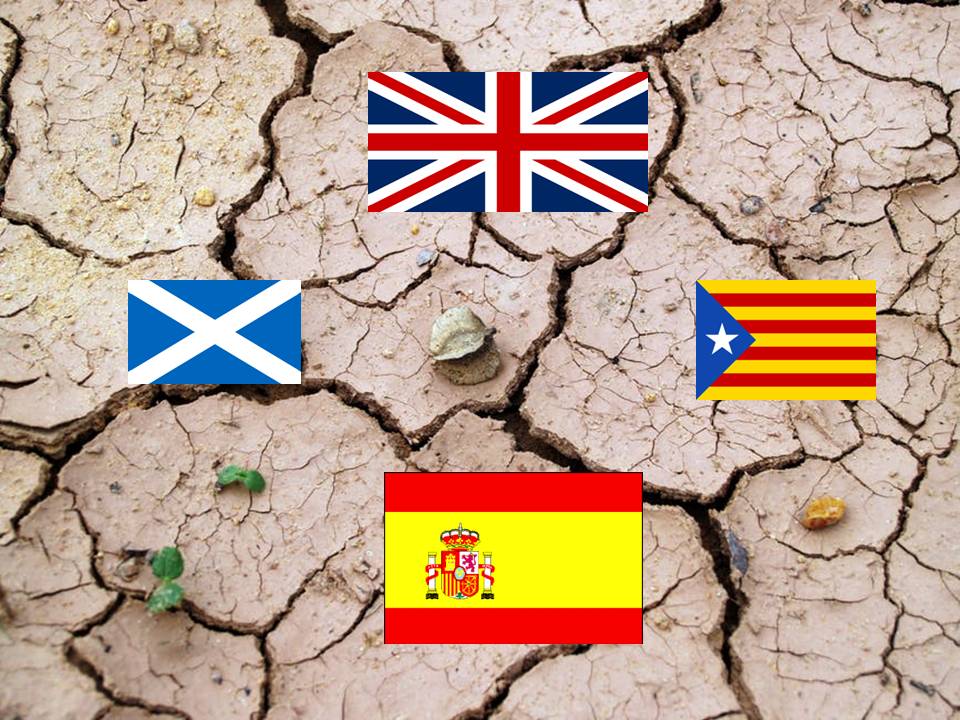
Given the plethora of struggles, it is the United Kingdom that faces the gravest threat. Scotland’s External Affairs Secretary Fiona Hyslop noted that the people of Catalonia ‘must have the ability to determine their own future’, but stopped short of openly recognizing the budding state. With Northern Ireland and Wales also harbouring secessionist movements, it is the enthusiasm of First Minister Nicola Sturgeon to discuss a further referendum on Scottish independence in autumn next year that appears the immediate consequence.

The occult of October could very well return in a year’s time as the focus moves from Spain to the United Kingdom in October 2018.

-   -   AWARELOGUE EDITORIAL

Saturday, April 1, 2017

BREXIT AND SOVEREIGNTY: THE DILEMMA OF PROTECTION

Brexit
Invoking Article 50 has commenced the process by which the United Kingdom will achieve once again, that which the majority sought. The degree of involvement, proportion of trade and final details of removing themselves from the European Union will take years to finalize yet the act is now final. Drafted to make the EU ‘more democratic, more transparent and more efficient,’ the Lisbon Treaty of 2007, which came into effect in 2009, made it possible for member states to opt out when so desired. The vision with which the Union was carefully crafted, the process of integration and the effort exerted in bringing it to its current state, stand questionable today. While regionalism bears a direct impact on sovereignty, European states themselves chose, voluntarily, to deepen their partnership over the decades.   

Sovereignty, its protection and preservation, remains at the core of national interest. Westphalia has been credited often with having spurred the identification of sovereignty and ensured the state became the political institution embodying it. Articles 73 and 76 of the Treaty which refer to ‘Lordship and Sovereignty’ and ‘Jurisdiction and Sovereignty’ respectively, detail the term in connection with governance and justice, and this it is presupposed is what forms the basis of equating the term to 1648. Yet it has been argued by J. R. Strayer that sovereignty as a practice, though not a term was in use centuries before in the 1300s between France and England. Daniel Philcott accepting this claim highlights that ‘two centuries of civil war delayed sovereignty’s lasting consolidation’ and argues that ‘Westphalia indeed made sovereign statehood a norm.’

Thus preservation of sovereignty is the raison d’être of states. Thomas J. Biersteker and Cynthia Weber observe that ‘throughout the course of history, the meaning of sovereignty has undergone important change and transformation – from the location of the source of legitimacy (in God, in the monarch or in the people) – to the scope of activities under its protection.’ While Stephen D. Krasner believes that sovereignty relates to ‘a system of political authority based on territory, mutual recognition, autonomy and control,’ Peter Hägel is of the view that ‘the concept of sovereignty designates a form of rule that is intrinsically entwined with the emergence and existence of the modern states system.’

The march of the Europeans towards consolidation into one region, dates back centuries as attempts had been at varying times and for differing periods to amalgamate the region. Carried out more by force than choice in the past, the mood post-Second World War favored the option of integration to avoid the ravages of war, which Europe had endured too frequently and for too long. States understood the implications of integration which would come at a cost to sovereignty, yet they chose the former for the greater good of the region. British leaders too comprehended the ramifications when attempting to enter and finally secured a berth for Britain in an integrated Europe.

The process, although taking several decades to realize a functional model of regionalism, was unique, from formation and implementation to deep integration across a variety of sectors. It reached another milestone as the Cold War ended, membership expanded and integration grew strong. Yet Daniel Philcott notes that ‘among the hallowed things that fell with the Berlin Wall was the sanctity of absolute sovereignty in international relations, the principle that within their borders, state institutions are untouchable, inviolable and supreme.’ Hinsley’s ‘absolute sovereignty’, which Philcott alludes to, and which was subsequently developed by Hobbes, Bodin and Rousseau, entails the ‘idea that there is a final and absolute political authority in the political community... and no final and absolute authority exists elsewhere.’

Thus sacrificing absolute control, power and supremacy was part of the price that states paid for integration and a price, it may be argued, that is worth paying given that which accrues to a single state through membership in a regional body, especially the EU. Philcott notes that ‘this (began) a generation earlier when European states pooled their sovereignty over trade, commerce, and other affairs into the institution of the European Community.’

The demand for preservation of sovereignty, which dominated the debate, raises several causes for concern. While England voted to leave with 53.2% opting out as opposed to 46.8 who preferred to stay in, Wales saw 51.7% deciding it was best to exit and 48.3% chose to remain. The irony of arguing on the basis of sovereignty as a pillar upon which the Brexit camp chose to campaign was severely questioned when considering the results of Scotland and Northern Ireland. Whilst a massive 62% of Scottish voters chose to remain as opposed to 38% opting to leave the EU, Northern Ireland saw 55.7% supporting the Bremain camp and 44.3% not.

The result could have been considered rational had it been spread evenly across the nation, yet the state realized the danger lurking in the result when Scottish First Minister, Nicola Sturgeon announced on the morning after that she would ‘take all possible steps and explore all possible options to give effect to how people in Scotland voted - in other words to secure our continuing place in the EU, and in the single market in particular.’ Given that this referendum came two years after a vote in Scotland which explored the possibility of independence, her view that ‘an independence referendum is now highly likely but I also think it is important that we take time to consider all steps and have the discussions, not least to assess the response of the European Union to the vote that Scotland expressed,’ was met in all seriousness when Prime Minister Theresa May opted to fly first to Scotland the day after she was sworn in, to reassure the Scottish First Minister and people of her ‘commitment to preserving this special union that has endured for centuries.’ The last few weeks have seen Sturgeon stoking the fires of independence once again, drawing attention to the subject.

Gerry Adams, the Sinn Fein President has noted that ‘the British government should respect the popular vote in the North for European Union membership by bringing forward a referendum on Irish unity. The Irish government, too, should act on this,’ indicated the fragility of Britain’s unity casting doubts over the effectiveness of the Brexit camp’s main slogan. Adams’ apprehension over the Good Friday Agreement and its buried divisions, the North-South border and its near-vanished nature, the economy and trade, and chiefly over democracy, creates concern in London. His acclamation that Irish Prime Minister Enda Kenny supported his ‘proposal for an All-Ireland forum of political parties and civic partners to deal with the consequences of Brexit,’ would augur well for Irish unity and strengthen sovereignty therein yet erode that which was hitherto sought and enjoyed by Britain.

Peter J. Katzenstein’s view that ‘it is the convoluted interconnections of countries and regions that define the current global order’ would resonate in the corridors of Europe, as it makes a choice of ascending that order, precariously hanging on or be forced to commence descending, thereby sacrificing all that it has come to represent. President Hollande lamenting the vote last year, was quick to note that ‘it's a decision that was taken by the British people...it is the British who will have to bear the consequences,’ thus indicating where the onus lay.

For sovereignty and its campaigners, questions arise as to whether it has been preserved in the spirit in which it was intended, or has it faced its most trying moment and projected what is to come, with the statistics and sentiments emanating from Scotland and Northern Ireland.  

Churchill’s warning that the best argument against democracy was a five minute conversation with the average voter, has been ignored by his own country and party, who chose instead to follow his paradoxically-opposed argument that democracy is the worst form of government, except all the others. Irrespective of whether democracy is the preferred choice or not, the British people have spoken and their leaders have pledged to carry forward their decision. Britain has been able to hold sway over global politics once more.

S.Saraswathi’s contention that ‘Brexit is an outcome of the inevitable conflict between the requirements of State sovereignty and the terms governing regional integration (and that) it is a democratic decision,’ denotes the nature of democracy itself.